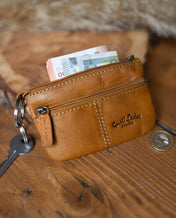
Leather finishing refers to the final steps in the leather-making process, during which the surface properties and appearance are tailored to achieve the desired colour, gloss, texture, and durability. Finishing gives each leather piece its final character. In this article, you’ll learn about the four main stages of leather finishing, from priming to embossing.
Fun fact: Some leather properties, like softness, fullness, and structure, are already shaped during wet finishing, which refers to the earlier stages of tanning. Surface finishing then comes to refine and protect the result.

Why does leather have to be finished?
Finishing goes well beyond colour application. It also encompasses waterproofing, ironing, and embossing. Pull-up leathers, for example, are treated with waxes or oils during finishing to nourish the material in depth and create a natural patina effect — this is known as wax or oil finishing.
The four main stages of finishing are as follows.
1. Priming
The first step is to apply a primer to open-pored aniline leather to "fill" the surface. This allows the colour to distribute evenly rather than being absorbed unevenly by the hide. The primer also improves adhesion, ensuring the pigment layer holds firmly and durably to the surface.
2. The colour layer
Once the primer has been applied, the colour layer is added, consisting of pigments and binders. This is the step that defines the final shade of the leather. It’s also referred to as pigmentation, finishing, or head dyeing, depending on the context.
3. The top coat
The top coat, also called the finish or finishing age, is applied over the colour layer. It acts as a clear coat, protecting the colour from fading and abrasion. It also determines the level of gloss and the feel of the leather. For matte leathers, like those used in cars or on leather-covered dashboards, a matting agent is added to this layer.
4. Ironing and embossing
As a final step, the leather can be ironed and/or embossed depending on the desired effect. Ironing smooths the surface and can give it a glossy finish, while also making the leather more durable and easier to maintain. Embossing imprints a new grain or decorative pattern onto the leather through stamping or rolling.

FAQ: Your questions about leather finishing
What is the difference between matte and glossy leather?
The level of gloss is determined during the top coat application. For matte leather, a matting agent is added to the top coat. For glossy leather, the top coat is applied on its own, sometimes followed by an ironing step that smooths the surface and enhances the shine.
What is pull-up leather?
Pull-up leather is leather that has had waxes or oils applied to it during finishing. When stretched or pulled, it lightens slightly at that spot before returning to its original shade. This gives it a lively, living appearance and the natural patina that we know and love.
Is embossing a defect?
Not at all. In fact, embossing is a deliberate technique. It allows a grain or decorative pattern to be imprinted on leather that does not exist naturally on the raw hide, such as crocodile, ostrich, or geometric patterns.
Does finishing affect the durability of leather?
Yes. A well-applied top coat protects the leather against wear, discolouration, and friction. Ironed leather is also easier to care for on a daily basis. The quality of the finishing is therefore directly linked to the longevity of the finished product.

Finishing at Gusti Leather: Craftsmanship in the service of quality
At Gusti Leather, every finishing step is carefully considered to ensure that our products are beautiful, durable, and pleasant-to-touch. Whether it is a naturally waxed leather or an embossed accessory, finishing is what sets ordinary leather apart from a piece that will accompany you for years to come.
Discover our collection of leather bags and accessories, crafted with care.